World Development Report 2024
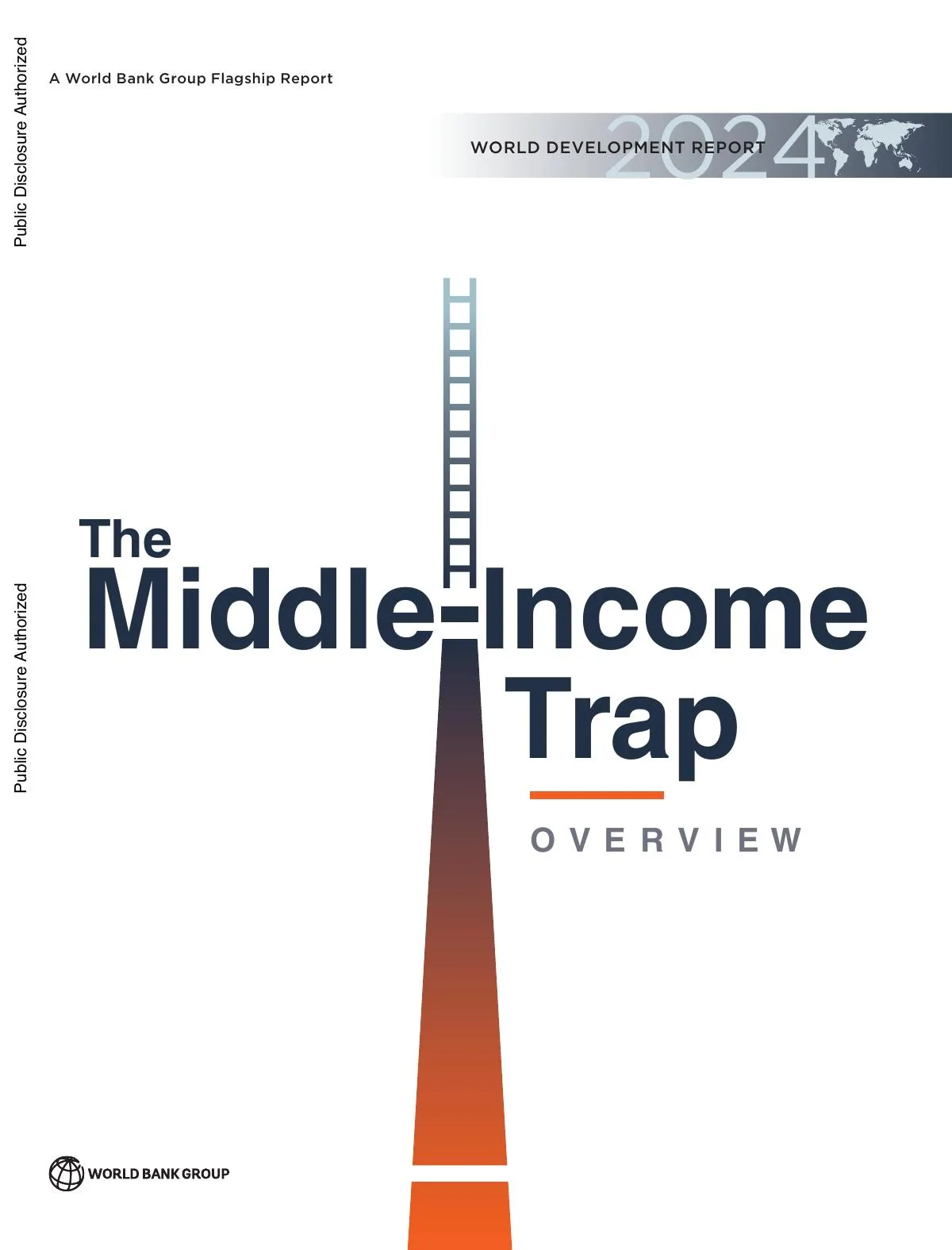
The Middle-Income Trap.
Why most middle-income countries stall, and the three-part sequence that lets a few break through.
Ufuk Akcigit, Co-Director of the Growth Academy, served as Academic Lead of this report. Somik Lall directed it. The Growth Academy was created around its findings.

Chapter 1 · The stakes
Six billion people, and a single question.
The World Development Report 2024 begins with a sobering arithmetic. The World Bank classifies 108 countries as middle-income, those with annual income per capita between US$1,136 and US$13,845 (Overview p.16). They are home to roughly six billion people, three out of every four people on the planet, and nearly two-thirds of those living in extreme poverty (Overview p.13, p.8). They generate about 40 percent of global economic output and account for more than 60 percent of global carbon dioxide emissions (Overview p.16). The central question the Report poses is stark. How should 108 countries that hold 75 percent of the world's people, 60 percent of its emissions, but just 40 percent of its output close that gap and converge toward the living standards of advanced economies (Overview p.23)?
World Bank, World Development Report 2024, Overview
people live in middle-income countries
Overview p.13
of the world's people
Overview p.23
of global economic output
Overview p.16
of global CO₂ emissions
Overview p.16
nearly two-thirds of people in extreme poverty live in middle-income countries.World Bank · WDR 2024 Overview
Chapter 2 · The record
Since 1990, only thirty-four escaped.
The record offers little comfort. Over the last 34 years, only 34 economies have succeeded in breaking out of the middle-income range into high-income status (Overview p.16). Their combined population is less than 250 million, roughly the population of Pakistan (Overview p.13). The structural ceiling is just as telling. Since 1970 the mean income per capita of middle-income countries has never risen above one-tenth that of the United States, and since the 1970s the median middle-income country has stayed below a tenth of the US level (Overview p.15, p.14). Economic expansion tends to decelerate and plateau at about 11 percent of US GDP per capita, which today would be roughly US$8,000, around the threshold where countries are firmly considered upper-middle-income (Overview p.16). This is the trap: a recurring stall well short of the frontier.
World Bank, World Development Report 2024, Overview
Chapter 3 · The diagnosis
Capital is not the missing ingredient.
The Report's diagnosis of why growth stalls is precise. Countries growing out of low-income status typically rely on a 1i strategy for accelerating investment, and that works well in early development (Overview p.30). But a 1i strategy is not enough to sustain growth through the middle-income range, because the returns from capital investment alone decline steadily (Overview p.30). Many middle-income governments nonetheless keep relying mainly on policies designed to expand investment. The Report's image for this is memorable: it is like driving a car just in first gear and trying to make it go faster (Overview p.8). More capital, on its own, cannot carry an economy to the frontier.
The diagnostic that names what is missing is the so-called gap accounting. If capital endowments were the only economically relevant difference between middle-income and high-income countries, the gross national income per capita of a typical middle-income country would have been nearly three-quarters of the US level in 2019. In fact it is about one-fifth (Overview p.16). The missing four-fifths is not capital. It is the ability to absorb, diffuse, and eventually generate ideas. That is what the Report's central framework addresses.
Chapter 4 · The way out
Investment, infusion, innovation, in sequence.
The proposed answer is a sequenced, three-pronged approach the Report calls the 3i strategy: first investment, then infusion of new technology from around the world, and then innovation (Overview p.7). The three drivers must be recalibrated additively and progressively as a country moves through middle-income status (Overview p.17). Investment means accelerating capital formation, the engine of early growth. Infusion means deliberately bringing modern technologies and successful business processes from abroad and diffusing them across the domestic economy (Overview p.17). Innovation means building domestic capabilities to add value to global technologies and ultimately to push the frontier outward, not just borrow from it (Overview p.13). Crucially, countries cannot leap all at once from investment-driven growth to innovation-driven growth. Infusion of technology comes first and then innovation (Overview p.17).
This is why the Report insists on not one but two transitions during the middle-income stage (Overview p.13). The first transition moves a country from a 1i strategy to a 2i strategy emphasizing both investment and infusion, in which lower-middle-income countries focus on imitating and diffusing modern technologies (Overview p.13, p.17). The second transition adds innovation to the investment-and-infusion mix, the 3i strategy, primarily for upper-middle-income countries that have begun to exhaust the potential of infusion and are running out of technologies to learn and adopt (Overview p.17, p.22). The Report is candid that these transitions are not automatic, that the shifts from 1i to 2i to 3i are neither smooth nor linear, and that there are no shortcuts to innovation (Overview p.13, p.22). Weak institutions are as debilitating as premature attempts to leapfrog from investment straight to innovation (Overview p.22).
World Bank, World Development Report 2024, Overview
Chapter 5 · The evidence
Convergence is possible, and reversible.
The convergence record gives the framework empirical weight. The Republic of Korea was among the least developed countries in the early 1960s, with income per capita below US$1,200 in 1960; by 2023, after a five-decade run of high output growth, it had reached about US$33,000 (Overview p.19). Worker productivity tracked the same climb, from just 20 percent of the average US worker in 1980 to more than 60 percent by 2019 (Overview p.22). Korea's path followed exactly the sequence the Report prescribes: it added infusion to accelerated investment, then augmented the 2i mix with innovation policies as its firms caught up to foreign frontiers (Overview p.19, p.20). Poland shows a discernible Korea-like 1i to 2i to 3i transition, lifting income per capita from 20 percent of the EU average to 50 percent since the early 1990s (Overview p.20). Chile, the first Latin American country to reach high-income status, did so in 2012 (Overview p.21). By contrast, Brazilian workers fell from 40 percent of US productivity in 1980 to just 25 percent by 2018 (Overview p.22), a cautionary mirror image of stalled convergence.
World Bank, World Development Report 2024, Overview
By the numbers
- 108
- Middle-income countries (income per capita US$1,136 to US$13,845)
- 34
- Economies that graduated to high-income in the last 34 years
- 6 billion
- People living in today's middle-income countries
- below one-tenth
- Median middle-income income per capita relative to the US level since the 1970s
- one-fifth
- Typical middle-income GNI per capita vs the US, against nearly three-quarters if only capital differed
- about US$33,000
- Korea's income per capita by 2023, up from below US$1,200 in 1960
WDR 2024 Overview p.16
WDR 2024 Overview p.16
WDR 2024 Overview p.13
WDR 2024 Overview p.14
WDR 2024 Overview p.16
WDR 2024 Overview p.19
Chapter 6 · The prescription
Discipline, sequencing, and the timing of reform.
What the diagnostic asks of policymakers is discipline and sequencing rather than ambition alone. The economies that made speedy transitions encouraged enterprise by disciplining powerful incumbents (large corporations, state-owned enterprises, and powerful citizens), developed talent by rewarding merit, and capitalized on crises to change policies and institutions that no longer served their purpose (Overview p.14, p.13). The Report frames the underlying obstacle as an imbalance among the forces of creative destruction: in middle-income countries the forces of creation are weak, the forces of preservation are strong, and destruction is held back by preservation (Overview p.29). Contestability, exposing domestic firms to competition from international firms near the global frontier, is central to creative destruction (Overview p.30). The same logic governs the energy transition, where high-carbon coal has been an entrenched incumbent for over 300 years and middle-income countries account for 93 percent of explicit fossil fuel subsidies (Overview p.23, p.37).
The urgency is in the timing. At current trends it will take China more than 10 years just to reach one-quarter of US income per capita, Indonesia nearly 70 years, and India 75 years (Overview p.8). The Report concludes that it would be a miracle if today's middle-income economies manage to do in 50 years what Korea did in just 25 (Overview p.38). The countries that hope to follow Chile and Poland, among them Bangladesh, Brazil, China, India, Indonesia, Mexico, Morocco, South Africa, Turkiye, and Viet Nam, are being asked to sequence their reforms deliberately: time the move from investment-led growth to infusion of know-how from abroad, and only then commit sizable resources to innovation (Overview p.38). The trap is not destiny, but escaping it requires getting the order right.
The trap is not destiny, but escaping it requires getting the order right.
Ufuk Akcigit served as Academic Leadof the World Development Report 2024. Somik Lall was its Director. Every figure on this page is cited to the report’s Overview.