The Growth
Academy

What we produce

The Academy's intellectual output.

Featured papers, applied case studies, and the World Development Report. Filter by theme, by type, or by year. Click in for the full read.

Filter by theme and type

10 papers

Working paper

2025

Country case studies · Firm dynamics

Engineering Ukraine's Wirtschaftswunder

Ufuk Akcigit, Furkan Kilic, Somik Lall, Solomiya Shpak. NBER Working Paper 34103, 2025.

Twenty-five years of firm-level data from Ukraine show why a competitive economy hollowed out long before the war. Top four manufacturing firms grew from 49 to 53 percent of market share. Productivity growth collapsed from 15.2 percent annually (2002 to 2013) to 3.7 percent (2014 to 2019). New firms attempting transformative products are absorbed by incumbents on a ten-month average. Industries receiving offshore-financial-center investment show 27 percent lower entry rates.

Reconstruction spending without structural reform will rebuild the same captured economy. Ukraine's Wirtschaftswunder requires institutional remedies, not balance sheets.


WDR contribution

2024

Country case studies · Innovation policy

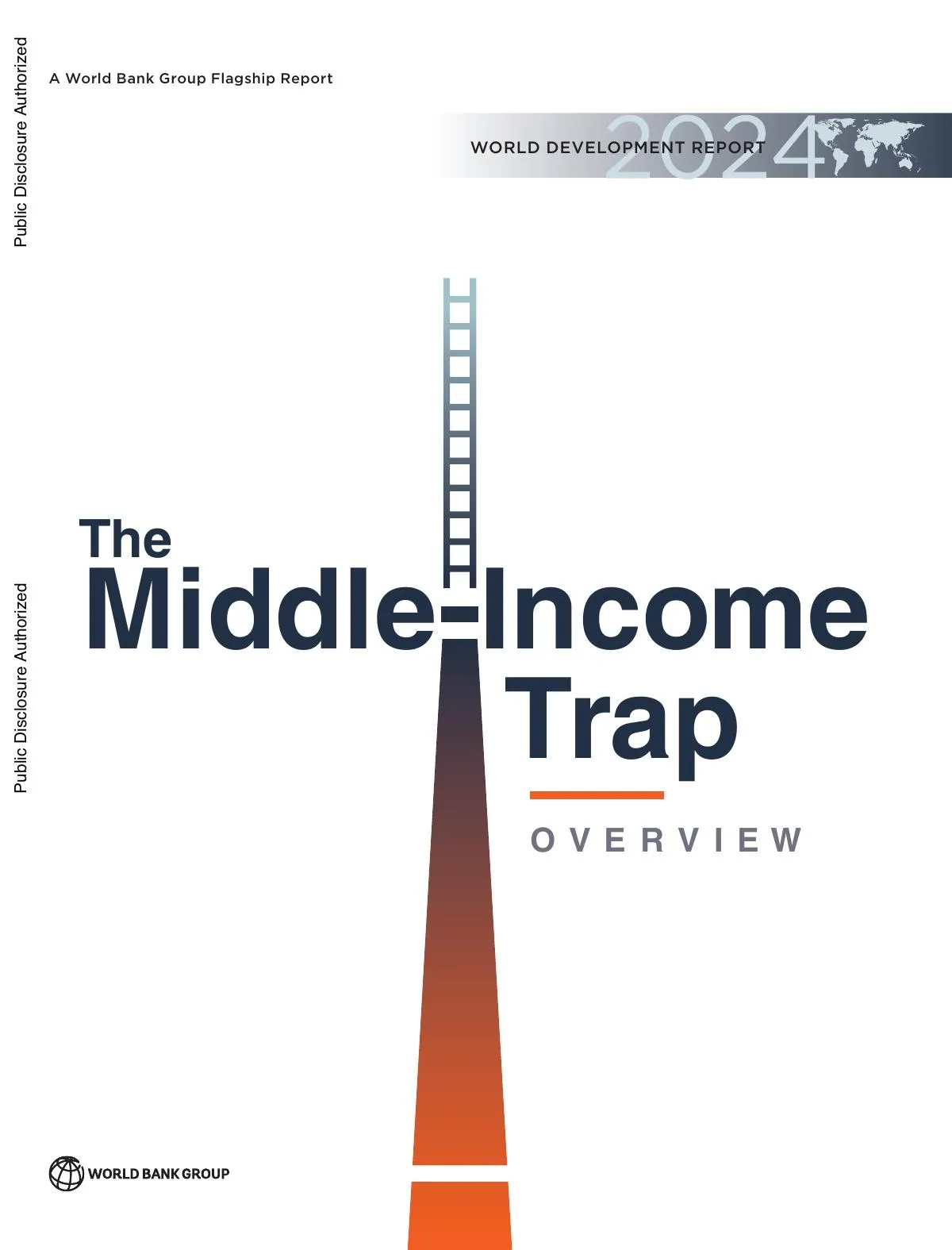
World Development Report 2024: The Middle-Income Trap

World Bank, Lead academic: Ufuk Akcigit. World Bank Group, 2024.

The Bank's clearest articulation of why the climb from middle-income to high-income status gets harder for most countries. Introduces the 3i framework: investment, infusion, innovation. The book that the Growth Academy was built around.

Middle-income countries cannot grow by doing more of what worked at low income. They need to switch from accumulation to absorption to innovation, in sequence.

Featured paper

2023

Firm dynamics · Innovation policy

Connecting to Power: Political Connections, Innovation, and Firm Dynamics

Ufuk Akcigit, Salomé Baslandze, Francesca Lotti. Econometrica, 2023.

What political connections do to firm-level innovation in Italy. Connected firms hire more, grow faster, and innovate less. The paper identifies the mechanism using Italian patent records and firm-politician matching: connections substitute for innovation rather than complement it.

Where political access can be substituted for productivity, expect both more political activity and less productivity. Pillar 01 of the Academy's diagnostic begins here.

Featured paper

2023

Firm dynamics · Creative destruction

What Happened to U.S. Business Dynamism?

Ufuk Akcigit, Sina T. Ates. Journal of Political Economy, 2023.

The textbook account of why the U.S. economy's startup rate fell, why the largest incumbents grew larger, and why aggregate productivity growth slowed. The paper builds and estimates a structural model that nests ten stylized facts about the American firm distribution.

The decline in U.S. dynamism is not a mystery. It is a measurable consequence of falling knowledge diffusion and rising barriers to imitation. Both are policy levers.

Featured paper

2018

Creative destruction · Firm dynamics

Innovation, Reallocation and Growth

Daron Acemoglu, Ufuk Akcigit, Harun Alp, Nicholas Bloom, William Kerr. American Economic Review, 2018.

The canonical structural model of an economy where heterogeneous firms innovate, enter, exit, and reallocate. Used as the workhorse for evaluating R&D subsidies, entry subsidies, and incumbent taxation across a range of policy counterfactuals.

Subsidizing R&D for incumbents helps the wrong firms. Entry subsidies and the credible threat of exit do more for aggregate growth.

Featured paper

2025

Talent · Innovation policy

Tapping into Talent: Coupling Education and Innovation Policies

Ufuk Akcigit, Jeremy G. Pearce, Marta Prato. Review of Economic Studies, 2025.

Why a country cannot make great inventors without making the right kind of education investment. The paper estimates how much of the inventor distribution is missing because of underinvestment in the long tail of basic schooling, and what it costs at the frontier.

R&D subsidies aimed at the top of the talent distribution leave most of the prize on the table. The marginal inventor lives in the tail, and the tail is built in primary school.

Featured paper

2020

Country case studies · Firm dynamics

Facts on Business Dynamism in Turkey

Ufuk Akcigit, Yusuf Emre Akgunduz, Seyit Mümin Cilasun, Elif Özcan-Tok, Fatih Yilmaz. European Economic Review, 2020.

Why Turkish firms stopped growing, told in declining startup rates and the rising market share of incumbents. The paper assembles a near-universal panel of Turkish firms and documents a pattern that mirrors the American slowdown a decade later.

Turkey's productivity slowdown was visible in firm-level data five years before it was visible in macro aggregates. The diagnostic was available; the response was not.

Featured paper

2021

Firm dynamics · Country case studies

Lack of Selection and Limits to Delegation: Firm Dynamics in Developing Countries

Ufuk Akcigit, Harun Alp, Michael Peters. American Economic Review, 2021.

A model that explains why firms in poorer countries do not grow. The mechanism is delegation: when an entrepreneur cannot trust a hired manager, the firm is capped at the size the founder can personally oversee. The paper estimates the cost of that ceiling at the macro level.

The size distribution of firms in poor countries is not a technology problem. It is an institutional one: contract enforcement, accounting standards, and managerial labor markets.

Featured paper

2021

Firm dynamics · Creative destruction

Ten Facts on Declining Business Dynamism

Ufuk Akcigit, Sina T. Ates. AEJ: Macroeconomics, 2021.

The empirical baseline. Ten facts that any theory of the U.S. slowdown must match: declining startup rates, rising market concentration, slowing productivity, falling labor reallocation, and others. The paper any successor cites first.

If the model does not reproduce these ten patterns, it is not modeling the right economy.

Featured paper

2022

Innovation policy

Optimal Taxation and R&D Policies

Ufuk Akcigit, Douglas Hanley, Stefanie Stantcheva. Econometrica, 2022.

The R&D policy paper most cited by treasury economists. Combines an endogenous-growth model with an optimal-tax framework to compute the welfare-maximizing combination of corporate taxes, R&D subsidies, and patent-box treatment.

There is a determinate optimal R&D subsidy and corporate-tax pair. Most countries are at neither.

The World Bank’s flagship World Development Reports, including the 2024 Middle-Income Trap that Ufuk Akcigit led as Academic Lead, stand on the reports shelf.

Working papers and the broader publication record live at Akcigit at NBER and Google Scholar.

The University of ChicagoBecker Friedman Institute for EconomicsWorld Bank Group Institute for Economic Development