World Development Report 2025
Standards for Development
Why the shared rules that make plugs fit sockets are a hidden engine of development, and how poorer countries can use them.

By the numbers
- nearly 90 percent
- Share of trade now affected by nontariff measures, up from 15 percent in the late 1990s
- 7 percent
- Share of active ISO technical committees on which low-income countries participate, versus 84 percent for high-income countries
- fewer than 100
- Accredited ISO-compliance auditors in Ethiopia, compared with 12,000 in Germany
WDR 2025 Overview p.2
WDR 2025 Overview p.19
WDR 2025 Overview p.xv
What the report argues
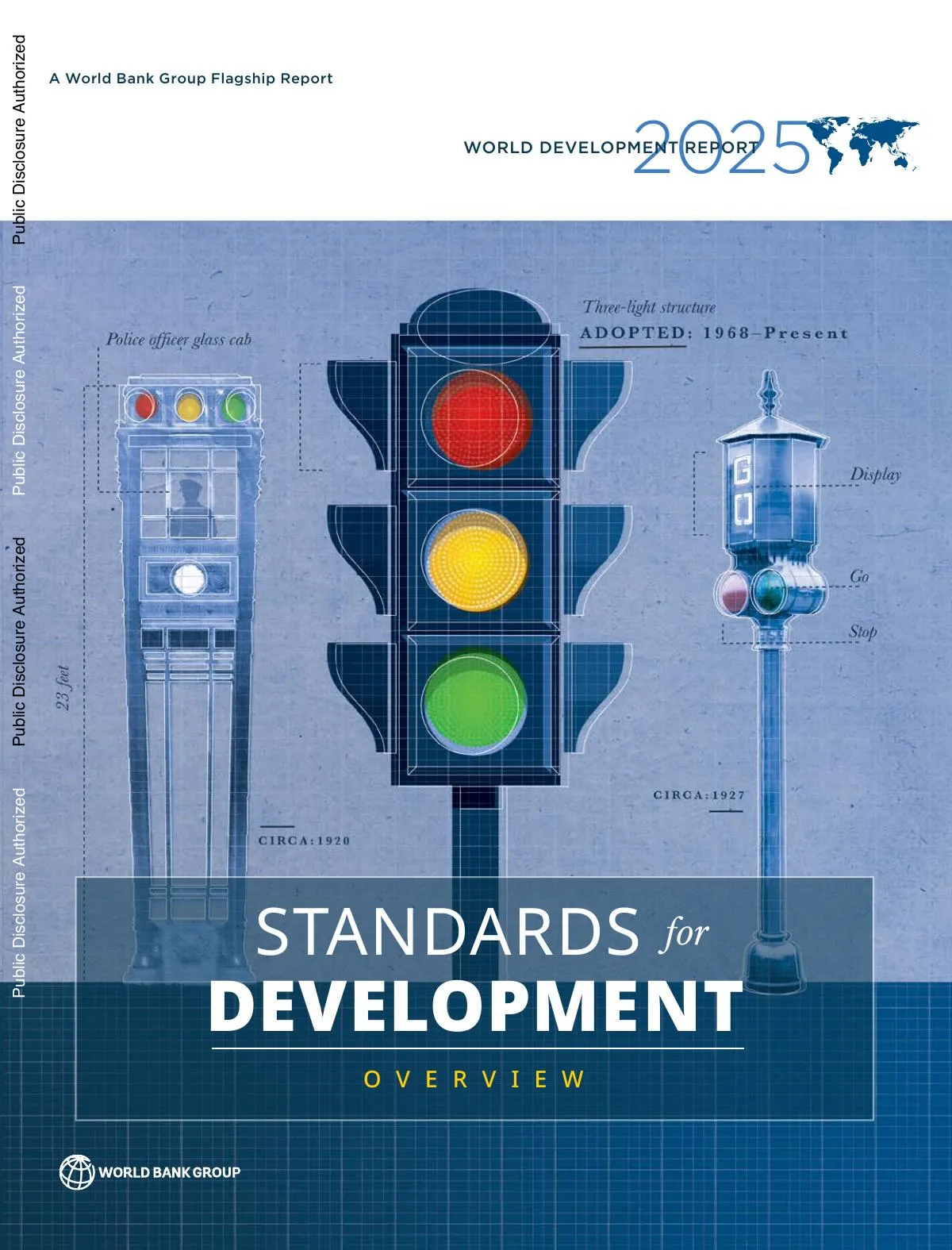
The World Development Report 2025, titled Standards for Development, makes the case that standards, the shared rules underpinning consistency, compatibility, and quality, are part of the invisible infrastructure of modern economies, as vital to prosperity as roads, ports, or power grids. The Report opens with Malcom McLean's standardized shipping container, codified by the International Organization for Standardization (ISO) in 1965, which delivered a 1,240 percent cumulative jump in trade among advanced economies after 15 years, by many estimates more than the combined effect of all trade agreements of the previous half century. The framing thesis is captured in a single image: treated as a springboard, standards propel development; made into a straitjacket, they stifle it. The Report describes itself as the first comprehensive analysis of the global landscape of standards and offers a practical policy framework for countries at every stage of development.
The analytical core is a typology of three functions and a progression. Standards perform three jobs: measurement (consistency essential for building, testing, and certification), compatibility (interoperability and substitutability that power scale and order), and quality (baselines for performance, safety, and reliability). The Report's central prescriptive framework is adapt, align, author. Countries at an early stage, where compliance capacity is typically low, should adapt international standards to domestic conditions as needed. At more advanced stages they should align domestic markets with international standards. At all stages they should author standards in priority areas where they have built expertise, by showing up at the committees of international standards development organizations and commenting on drafts. The organizing tension throughout is matching ambition to ability: mandatory standards set too low forfeit quality in health, food safety, and the environment, while standards set too high and unenforceable invite uneven application, corruption, and market concentration.
To make standards work, the Report argues, countries must invest in quality infrastructure, the system of standardization, conformity assessment (testing, inspection, certification), accreditation (checking the checkers), and metrology (reliable measurement). It warns of conflicts of interest when resource-constrained national standards bodies merge incompatible roles, for example combining conformity assessment with accreditation, or setting standards while earning revenue from assessing compliance with them. The capacity gap is stark. The Report notes that Ethiopia has fewer than 100 accredited auditors for compliance with ISO standards, compared with 12,000 in Germany, and recommends starting with public provision of quality services in key sectors before gradually opening them to private participation, with the government eventually acting as referee rather than sole provider.
The Report then shows how standards serve four development objectives: growth, well-being, stability, and effective government. On growth, it documents that nontariff measures, many tied to standards, now affect nearly 90 percent of trade, up from 15 percent in the late 1990s, and warns that measures such as the European Union Carbon Border Adjustment Mechanism can widen the divide between rich and poor countries, citing Mozambique, which sends nearly 90 percent of its aluminum to the EU. It urges harmonization, mutual recognition agreements, and a tidying of the spaghetti bowl of overlapping voluntary standards. On well-being, it argues that process standards make services reliable: simple childbirth checklists reduced maternal deaths by nearly 47 percent in India, and clear teaching standards helped Ceara, Brazil, reach near-universal early-grade literacy within two decades.
On stability and safety, the Report treats financial and environmental standards as guardrails for managing the risks that growth itself can generate, pointing to the Basel Capital Accords as risk-calibrated models and to the air-quality crisis in which 99 percent of people worldwide breathe air dirtier than WHO guidelines consider safe. It stresses that meaningful environmental action depends on measurement: most of the world lives in places lacking reliable pollution-exposure data, with only 3.7 percent of governments in Africa, 6.8 percent in Asia, and 19 percent in Latin America providing dependable air-quality data. On governance, it frames budget, recruitment, and procurement standards as the hidden wiring that turns discretion into discipline across a public sector of 373 million workers, while cautioning that compliance itself carries administrative costs that must be sequenced and adapted to capacity, as Viet Nam did with its phased public-sector accounting standards.
A recurring theme is exclusion from the rule-writing process. Low-income countries participate in just 7 percent of active ISO technical committees, while high-income countries participate in 84 percent, and advanced economies send on average 525 delegates a year to ISO meetings against just 9 from low-income countries. The Report's policy table sets out paired agendas: developing countries should create incentives for firms to upgrade rather than impose unrealistic mandates, adapt and sequence standards (using tiered requirements and transition periods, as in Rwanda's Grow with Standards program), participate actively in international forums, and share quality infrastructure regionally. The global community, in turn, should fund and support developing-country participation, design tiered standards, deepen regulatory cooperation, and build credible standards for frontier technologies.
The Report closes with a paradox and a candid epilogue. It observes a cornucopia of standards for inconsequential products alongside huge gaps for high-stakes technologies, noting pointedly that a bag of chips has about as many international standards as artificial intelligence, even as geopolitical rivalry stalls the cooperation the world needs. In a reflexive epilogue, the authoring team of development economists turns the lens on their own profession, citing evidence that researchers from developing countries remain underrepresented in top journals and in influential research networks, with less than 2 percent of BREAD fellows based outside Europe and the United States and just 6 percent of the Journal of Development Economics editorial board based in developing countries (none in Africa). The closing argument is plain: countries that take standards seriously are getting ahead, and those that ignore them risk falling behind.