World Development Report 2021
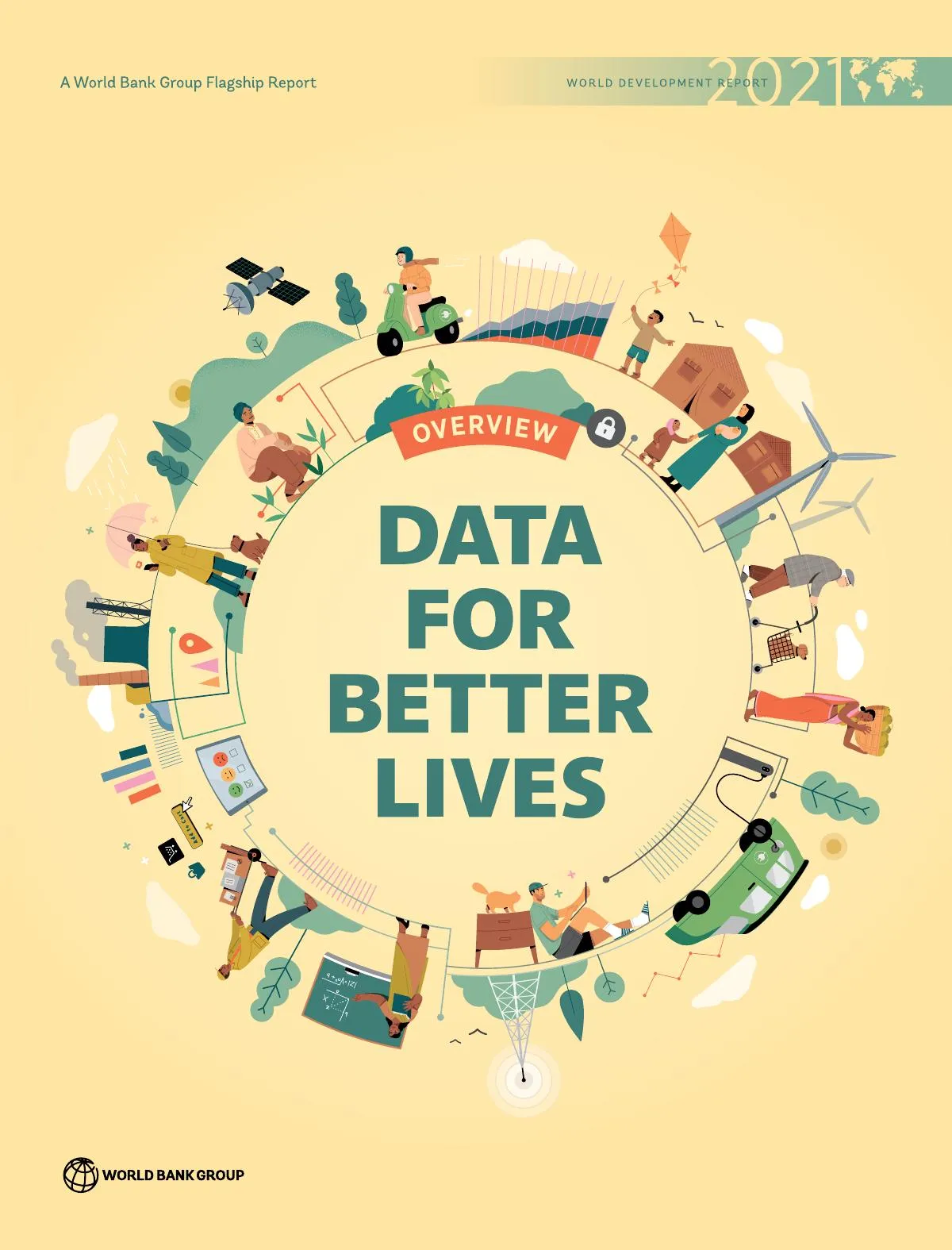
Data for Better Lives
Data can improve lives only under a new social contract built on value, trust, and equity.

By the numbers
- less than 20 percent
- Low- and middle-income countries with modern data infrastructure
- 5–6 percent
- Productivity gain for US firms adopting data-driven decision-making (2011 study of 179 firms)
- 130 million
- Nigerians who did not meet the sanitation standard, per a national survey
WDR 2021 Overview p.7
WDR 2021 Overview p.20
WDR 2021 Overview p.19
What the report argues
The World Bank's World Development Report 2021, Data for Better Lives, argues that the explosion of data is one of the defining shifts of the era, comparable to general-purpose technologies such as the steam engine and electricity, but that its benefits are not automatic. The report opens with a pointed question: does the growth of data matter for the more than 700 million people living in extreme poverty, or will poor people and poor countries fall further behind? Its answer rests on a key reframing. Simply gathering more data is not the goal. Data shortfalls in poor countries are real, but the priority is using data more effectively to improve development outcomes. As the report puts it, data improve social and economic outcomes only when they are used systematically to create information that generates insights that improve lives (Overview p.15).
The conceptual core is a theory of change linking data to development through three institutional pathways (Overview p.16). Governments and international organizations use data for evidence-based policy and better service delivery; civil society and individuals use data to monitor government and access public and commercial services; and private firms use data in production, fueling their own growth and wider economic growth. Two properties make data distinctive. Unlike capital, land, and labor, using data once does not diminish its value, and data collected for one purpose can be reused for an entirely different one. That reusability is the source of most of the value, but it is also the source of the danger. Each pathway that creates value also opens a door to harm: politically motivated surveillance and discrimination, cybercrime and the dark net, manipulative microtargeting, market concentration, and widening inequality.
To resolve the tension between the helpful and harmful potential of data, the report calls for a new social contract for data founded on three principles: value, trust, and equity (Overview p.18). The full value of data materializes when systems enable use and reuse for different purposes. A trust environment is created when the rights and interests of all stakeholders are safeguarded. And equity means all parties share in the benefits when investments and regulations create a level playing field. The COVID-19 response illustrates the stakes vividly. Repurposing aggregated call detail records helped track mobility in The Gambia and, in Israel, helped identify a substantial share of early coronavirus cases, yet the same individual-level tracking in Israel raised privacy concerns that led the Supreme Court to halt the program in April 2020. The report stresses that lower-income countries enter this bargain at a disadvantage, lacking the infrastructure and skills to turn data into value, the institutions and rules to create trust, and the scale and agency to participate equitably in global data markets.
The first part of the framework distinguishes public intent data, collected for public purposes such as censuses and administrative records, from private intent data, generated as a by-product of business activity. Public intent data can sharpen policy design, target scarce resources to marginalized groups, and hold governments accountable. A Nigerian water and sanitation survey, for example, revealed that 130 million Nigerians, more than two-thirds of the population at the time, did not meet the sanitation standard, prompting a national response (Overview p.19). Private intent data carry real economic power: a 2011 study of 179 large United States firms found that adopting data-driven decision-making raised productivity by 5 to 6 percent (Overview p.20). But these same dynamics bring risks, including opaque algorithms that can amplify discrimination and network effects that let a few large firms dominate. Combining and repurposing different data sources deepens the impact: pairing household surveys with satellite imagery in Tanzania raised the resolution of the poverty map from 20 regions to 169 districts, an eightfold gain with essentially no loss of precision (Overview p.21).
Part II of the report turns to data governance as the means to capture this value while guarding against harm, organized around four building blocks: data infrastructure policy, data laws and regulations, related economic policies, and data governance institutions (Overview p.22). Infrastructure access is deeply unequal: less than 20 percent of low- and middle-income countries have modern data infrastructure such as colocation data centers and direct access to cloud computing (Overview p.7), and many must route their own data through overseas facilities at a penalty in speed and cost. On the legal side, the report distinguishes safeguards (cybersecurity, personal and nonpersonal data protection) from enablers (open data policies, access-to-information rights, data portability), and finds that an adequate legal and regulatory framework remains a work in progress across all income groups. It also notes the implausibility of consent as currently practiced, citing the estimate that reading the privacy disclosures a person encounters in a year would take roughly 76 days (Overview p.25).
On economic policy, the report addresses competition, trade, and tax. Data-driven platforms tend toward increasing returns to scale and concentration, requiring antitrust enforcement adapted to markets where services are often free, alongside ex ante measures to make essential data accessible to rivals. Notably, no low-income country has completed a landmark platform antitrust case despite hosting the same dominant firms. Trade in data-driven services has grown to roughly half of all trade in services since 1990 (Overview p.26), and a country's personal data protection regime materially shapes its participation. On tax, governments of lower-income countries struggle to capture revenue from businesses with no physical presence, with estimates for East Asian countries suggesting losses of as much as 1 percent of GDP by 2030. Institutions tie this together: without well-mandated, adequately resourced, and technically capable bodies, laws and infrastructure will underdeliver.
Part III offers an aspirational vision of an integrated national data system, the network of highways that connects all users while governance provides the rules of the road. Such a system makes data production, protection, exchange, and use part of whole-of-government, multistakeholder planning, building on the four governance pillars and a foundation of human capital, trust, funding, incentives, and data demand (Overview p.29). The value of integration compounds with participation, since more participants mean exponentially more directions in which data can safely flow, illustrated by Estonia's X-Road exchange layer and its once-only principle. The report is candid that most countries are far from this goal and proposes a maturity model rather than a single blueprint. Its closing argument is unflinching: realizing the full value of data will be difficult and demand substantial commitment, but the cost of failing to change is a world of greater inequities and many missed opportunities.